


Multi-Hole Ceramic Film Disc
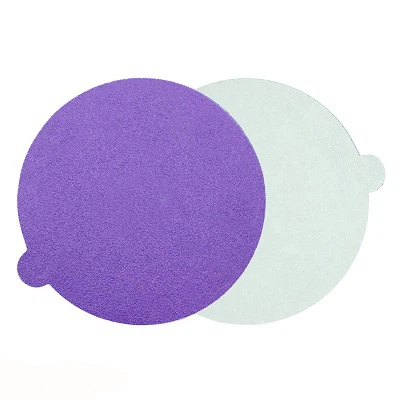
Two things kill a ceramic film disc mid-panel: heat and dust. The purple ceramic film sanding disc attacks both at once — self-sharpening ceramic grain on a water-resistant PET film backing, and a cyclone multi-hole pattern that sweeps debris off the disc in a spiral instead of letting it settle between the grains. Cut faster, sand cooler, change discs less — on filler, primer, and clear coat, wet or dry.
Product Introduction
Jiangxi Golden Abrasives Co., Ltd. is one of the leading manufacturers and suppliers of Multi-Hole Ceramic Film Disc in China. With abundant experience, we warmly welcome you to wholesale customized Multi-Hole Ceramic Film Disc at competitive price from our factory. If you have any enquiry about free sample, please feel free to email us.
What "High-Ceramic" Actually Changes on the Panel
Raising the ceramic share of the coating does three things you can feel during a shift, not just read on a datasheet:
- The ceramic film disc stays sharp into its second life. With more mineral in the coating, there are still fresh ceramic edges cutting when a standard-loading abrasive film disc is already rubbing. On long runs, this is the difference between one multi-hole ceramic film disc per job and two.
- Less heat in the panel. A sharp grain cuts with lighter pressure; a glazed one forces the operator to push, and pushing is what burns clear coat. The extra sharpness reservoir keeps pressure - and temperature - down late in purple abrasive film disc life.
- Steadier scratch on hard substrates. Hardened paint, E-coat, stainless, and composites are where thin coatings fail first. The denser grain bed keeps depth uniform instead of going patchy as the coat thins.
Two Grades, One Film: Which One to Stock
This high-ceramic grade and our standard ceramic film disc share the same purple film platform - same backing, same cyclone multi-hole pattern, same P40–P2500 range. The grain loading is what separates them:
| Standard ceramic grade | High-ceramic grade (this page) | |
|---|---|---|
| Grain loading | Standard ceramic coat | Raised ceramic loading, reduced filler |
| Best work | General refinishing: filler, primer, blending | Hardened clear coat, e-coat, stainless, composites |
| Work pattern | Short jobs, frequent grit changes | Long runs, production lines, all-shift sanding |
| Failure mode it prevents | - | Glazing and heat late in disc life |
Built for the Jobs That Eat Ordinary Discs
Four situations in our export markets keep coming back for this grade:
- Dry sanding hardened clear coat. Old clears and factory finishes are the fastest grain-killers in refinishing. The high ceramic bed keeps cutting where dry friction has already glazed a standard abrasive film disc.
- Stainless, alloys, and composites in metal fabrication and marine work - hard, sticky, or heat-sensitive surfaces that punish thin coatings.
- Production and robotic sanding stations, where a disc change stops a line. Life per disc is the number that gets measured.
- Hot climates and high-RPM tools - combined heat load is exactly what the extra mineral reserve is for.
Multi-Hole Ceramic Film Disc Specifications
|
Type |
AG781 Pro |
|
Specification |
150mm Multi Holes |
|
Grit Range |
P40-P2500 |
|
Grain |
Premium Ceramic |
|
Backing |
Polyester film backing |
|
Bonding |
Resin over Resin |
|
Coating |
Semi-open Coating |
|
Anti-clogging Layer |
Invisible Coating |
|
Application |
Woodworking, Automotive Refinishing, Metalworking |
|
Package |
P40-P60: 50pcs/customized box, 1000pcs/carton P80-P2500: 100pcs/customized box, 2000pcs/carton (Customized packages are available |
Grit Selection Guide for Multi-Hole Ceramic Film Disc
| Grit | Where this grade earns its keep |
|---|---|
| P40 – P80 | Heavy stripping of hardened paint and thick filler |
| P120 – P180 | E-coat and weld-burr leveling on panels |
| P220 – P320 | Primer sanding in high-volume booths |
| P400 – P600 | Dry pre-paint sanding on hard substrates |
| P800 – P1200 | Clear coat leveling where heat build-up is a risk |
| P1500 – P2500 | Fine finishing before polish |
User Evaluation
FAQ
01. How does the self-sharpening feature work?
02. What's the MOQ and lead time for OEM?
03. Can you customize hole patterns or sizes?
Hot Tags: Multi-Hole Ceramic Film Disc, China Multi-Hole Ceramic Film Disc manufacturers, factory, blue film sanding disc, 3m purple finishing film disc, Zirconium Abrasive Polishing Pet Film Sanding Disc, sunmight l312T
You Might Also Like


Send Inquiry
