


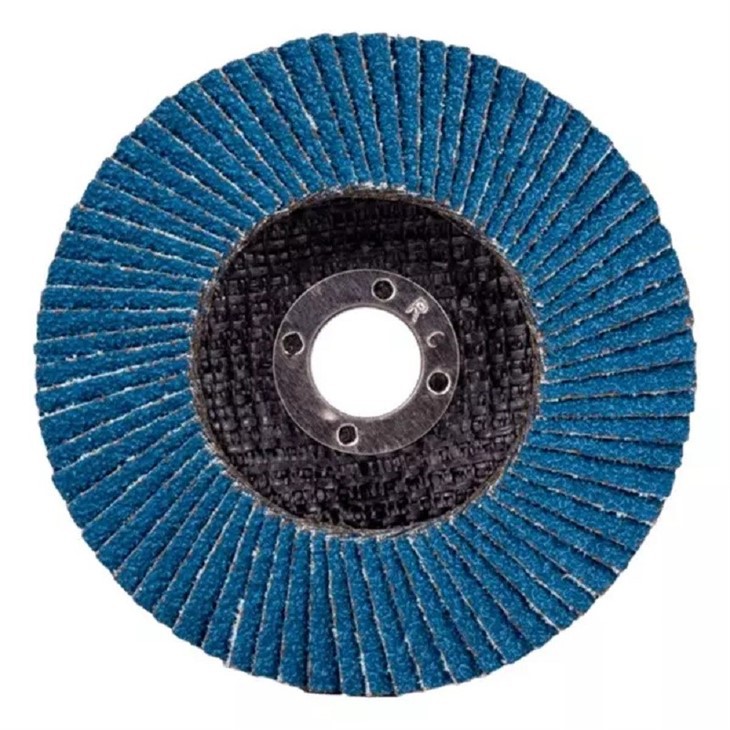
Flap Disc
Grinding wheels are one of the most commonly used abrasive products. Made from thousands of tiny abrasive grains, they remove material to both shape and refine a workpiece.
Different types of grinding wheels are available, and each type serves a different purpose. Some are sharpeners and cutters, while others are polishers and smoothers.


Fast stock removal
Flap grinding discs are designed to remove material quickly and efficiently. The overlapping abrasive flaps allow for aggressive grinding, resulting in faster stock removal compared to other abrasive products.
Versatility
Flap grinding discs are a versatile tool that can handle multiple tasks with ease. They can grind, blend, and finish in a single action, eliminating the need for switching between different tools or discs. This saves time and improves project efficiency.
Smooth finish
Unlike grinding wheels, flap discs are known for producing a smooth finish without gouging the surface. The layered flaps constantly expose new abrasive grains, ensuring a consistent and uniform finish.
Reduced noise and vibration
Flap grinding discs generate less noise and vibration compared to grinding wheels. The layered flaps act as a cushion, resulting in a quieter and more comfortable grinding experience.
Contouring capabilities
Flap discs are flexible and can easily conform to contours in the metal. This makes them ideal for shaping and smoothing surfaces, especially when working with right angle cuts.
Longer lifespan
Flap grinding discs have a longer lifespan compared to traditional grinding wheels. The overlapping flaps ensure that the abrasive material wears evenly, maximizing the disc's longevity and reducing the need for frequent replacements.
Wide range of options
Flap grinding discs come in various shapes, sizes, and grits to suit different applications. Whether you need to remove rust, paint, weld seams, or perform heavy-duty grinding, there is a flap disc available to meet your specific needs.
Why Choose Us
Rich manufacturing experience
More than 20 years abrasive products manufacturing in China, we’re familiar with our raw material manufacturers well, and also control raw material quality to ensure premium abrasive products.
Professional R&D
Our technical team workers commit to developing new products to provide different industrial applications solutions, and support customers to expand products range to enhance market competitive.
Well-trained team
Our team workers are well trained, customer requirement oriented, and provide professional solutions to meet customers requirement.
After sale service system
We pay more attention to our products market feedback, and follow up our products performance closely.Once we got some complaints from your customers, we'll submit the pictures and video to our technical department for analyzing, then provide you the solution to solve the issue in time.
Types of Flap Disc
Flat discs
Flat flap discs, also known as type 27 flap discs, typically grind best at shallower angles between 0 and 15 degrees. They are optimal for smooth finishing and blending on flat surfaces, and they can handle slight contours.
Conical discs
Conical flap discs, also known as type 29 flap discs, have a saucer-shaped grinding surface rather than a straight one. They typically grind best at angles between 15 and 35 degrees. They enable aggressive stock removal by maximizing surface contact on flat surfaces.
Trimmable discs
Trimmable flap discs differ from other types because they contain a trimmable composite backing that allows the operator to increase flap overhang. When used as intended, these discs offer flexibility and versatility needed for hard-to-reach areas such as fillet welds and irregular shapes. The backings also prevent unwanted marking of the workpiece.
Aluminum-backed discs
Flap discs with aluminum backs contain a sturdy, permanent aluminum backing. This backing provides rigorous support in high-stress, heavy-duty applications such as pipeline fabrication.
Mini discs
Mini flap discs are significantly smaller than their standard counterparts, only about 2 or 3 inches in diameter. Their compact size makes them ideal for working in tight spaces and grinding hard-to-reach areas on the workpiece. A smaller, 2-inch mini disc can often effectively replace a blending disc as well. These discs contain a composite backing that provides standard support for a range of applications.
Angled discs
Angled flap discs have curved flaps that wrap around the edge of the backing plate, facilitating extensive flap-to-metal contact, enhancing operator control and allowing for a wider range of grinding angles. The curved flaps give these discs the contouring capabilities necessary for fillet welds and allow for access hard-to-reach areas for T-joint grinding. They offer the same robust grinding performance on flat surfaces.
How to Use the Flap Disc
Select the appropriate product. Before use, it is necessary to choose the appropriate product, different workpieces need different products to achieve better processing results. For example, it is advisable to polish high-temperature alloys with graphite and high-speed steel for stainless steel workpieces.
Adjust the rotational speed. Adjusting the speed is a very important step when using abrasive shutters, and it is usually necessary to adjust the speed differently according to the workpiece of different materials. If the speed is too fast, it is easy to cause burns on the surface of the workpiece, and if it is too slow, it will affect the processing efficiency.
Maintain a stable feel. It is very important to maintain a stable feel when machining, especially when machining small workpieces. Unstable feel will easily lead to processing deviations, which will affect processing efficiency and processing quality.
Replace with new products in a timely manner. After a long period of use, the degree of wear will continue to increase, and if it is not replaced in time, it will affect the processing quality and may even damage the workpiece. Therefore, it is recommended to replace it in time after using it for a period of time.
Auto parts processing
It can cut, polish, and grind auto parts for better precision and surface quality.
Mold processing
It can cut, polish and grind the mold, make the surface quality of the mold more fine, and reduce the error in manufacturing.
Aerospace field
It can be used in the production and processing of aircraft engines, high-temperature alloy processing and other fields.
Medical machinery manufacturing
It can be used to process medical devices such as scalpel blades and dental equipment to ensure that the surface of the instrument is smooth and burr-free.

Disc shape: Flat, conical, and compressed
- Flap discs are mainly available in three common shapes.
- Flat flap disc or t27 disc- as the name suggests, these are used on flat surfaces for edge grinding and deburring.
- Conical flap disc or t29 disc- these discs are perfect for surface conduct and aggressive grinding. They are also used for heavy stock removal in different grinding applications.
- Compressed flap disc- this disc can perform both edge grinding and deburring as well as equally effective for heavy weld removal.
Bonding and backing materials
Poly-cotton fabric and polyester fabric are the two most common bonding and backing materials used in flap discs.
Backing plates: Fiberglass, plastic, and metal
Flap disc backing plates are typically made of three main components: Plastic, metal, and fiberglass.
Flap density
The total amount of abrasive area used by the flap on the disc is known as the flap density. The number of flaps used, the angle at which they are used, and the space between flaps all affect the size of the abrasive area. Low-density flap disc is good for heavy-duty applications and fast stock removal, while high-density flap discs are perfect for working on curved and irregular surfaces.
Grain types
Flap discs are designed with different types of abrasives including ceramic, zirconia, and aluminum oxide grains. You can choose the grain material according to your application requirement.
Abrasive grit and disc size
Abrasives are available in various grit range from coarse, to medium and fine. A high grit number means a small abrasive grain. Similarly, a low grit number means a large abrasive grain. For fine abrasive products choose high grit or small grain size. Flap disc with coarse abrasive grit is perfect for heavy stock removal and aggressive grinding. And, flap disc with medium or fine abrasive grit is perfect for deburring, mixing, and finishing applications.
Components of Flap Disc
Louvers
Louvres are an important part of sand-proof louvers. They are usually made of aluminum alloy and are lightweight, strong, weather-resistant, and easy to maintain. Louvers are combined at a variety of different angles to effectively prevent sandstorms from directly affecting the interior environment of the house.
Brackets
The brackets are the basis of the louvers. They are mainly made of steel, steel plates and other materials. Their stability and strength are very important. In actual projects, there are many ways to install the brackets, which can be selected according to actual conditions. Some sand-proof louver brackets are detachable or rotatable, and the angle and position of the louvers can be flexibly adjusted as needed.
Control system
The control system is a key component of sand-proof louvers. The louvers can be adjusted and controlled by intelligent control, manual or remote control. Some control systems also have wind and fire protection functions, and can be used in conjunction with efficient air filtration systems to ensure fresh air inside the house.
Material of Flap Disc
Plastic
Backing materials are available in a range of plastics, although nylon is the most common. You can trim these backings to extend flap use, particularly during mixing and finishing. Plastics are cost-effective and compliant, which explains their growing popularity.
Fiberglass
Fiberglass is one of the most sought-after backing material choices. It’s robust, lightweight and safe, forming a solid bond with the adhesive and eliminating the chance of contaminating the work surface. It also absorbs vibrations — excellent for operator comfort. As fiberglass also consists of layers, the more you add, the stronger the backing.
Phenolic
Manufacturers create phenolic products by combining resin layers with composite fabric. This backing is lightweight and durable, fantastic to avoid damaging the workpiece.
Metal
Metal backings are ideal for applications requiring extra support, strength and safety. However, they are more expensive, so using them only when necessary is perfect to maintain profitability.
Composite
This backing choice is ideal to prevent marking the workpiece. It’s a trimmable backing, so you can adjust the disc’s dimensions, allowing access to hard-to-reach areas.
How to Maintain Flap Disc
Clean the disc regularly
After each use, make sure to clean the flap grinding disc thoroughly. Use a brush or compressed air to remove any debris, dust, or metal particles that may have accumulated on the disc. This will prevent the buildup of material that can affect the disc's performance.
Store the discs properly
When not in use, store your flap grinding discs in a dry and clean environment. Avoid exposing them to moisture, extreme temperatures, or direct sunlight, as these factors can degrade the disc's abrasive properties.
Inspect the disc before each use
Before using a flap grinding disc, carefully inspect it for any signs of damage or wear. Look for cracks, frayed edges, or uneven wear patterns. Using a damaged disc can lead to poor performance and potential safety hazards. If you notice any issues, replace the disc immediately.
Use the correct pressure
When using a flap grinding disc, apply the appropriate pressure to achieve the desired result. Too much pressure can cause excessive wear on the disc, while too little pressure may result in ineffective grinding. Find the right balance to ensure optimal performance and longevity.
Use the correct speed
Different flap grinding discs have specific speed recommendations. Make sure to operate your angle grinder at the recommended speed for the disc you are using. Operating at a higher or lower speed can affect the disc's performance and result in premature wear.
Use protective equipment
Always wear appropriate personal protective equipment, such as safety glasses, gloves, and a dust mask, when using flap grinding discs. This will protect you from potential hazards, such as flying debris and dust particles.
How to Choose a Flap Disc
Grit size
The grit size of the flap grinding disc determines the coarseness or fineness of the abrasive material. Higher grit sizes, such as 80 or 120, are ideal for finer finishing and polishing tasks, while lower grit sizes, such as 36 or 40, are better for heavy material removal.
Disc size
Flap grinding discs come in various sizes, typically ranging from 4 to 7 inches in diameter. The size of the disc you choose will depend on the size of the workpiece and the area you need to cover. Smaller discs are suitable for precision work and tight spaces, while larger discs are more efficient for larger areas.
Flap configuration
Flap grinding discs have different configurations, including flat discs and conical discs. Flat discs are ideal for smooth finishing and blending on flat surfaces, while conical discs are better for aggressive stock removal and grinding at angles. Consider the shape of the workpiece and the type of grinding you need to determine the appropriate flap configuration.
Backing material
The backing material of the flap grinding disc can vary, with options like cotton, polyester, or a blend. Each material offers different levels of flexibility and durability. Consider the specific requirements of your project to choose the most suitable backing material.
Application
Finally, consider the specific application for which you need the flap grinding disc. Different discs are designed for various tasks, such as weld blending, rust removal, or general grinding. Choose a disc that is specifically designed for your intended application to achieve the best results.
Safety Precautions When Using the Flap Disc
Choosing the right dust-proof grinding wheel
Look for dust-proof grinding wheels that meet the EN 13743 standard and are marked accordingly. These wheels meet the highest safety standards.
Inspection before use
Before fitting a flap grinding wheel to a machine, carefully inspect it for any damage or defects. Discard any wheel that shows signs of damage.
Correct installation
Fit the flap disc according to the instructions in the machine manual. Make sure the flap disc is not too loose or too tight on the flange. Tighten the flap disc securely using the tool that came with the machine.
Protective equipment
Always wear the recommended personal protective equipment (PPE) when using flap grinding wheels. This includes goggles, ear protection, hand protection (gloves) and lung protection (dust mask or respirator).
Machine guards
Never remove the machine guards and make sure they are adjusted correctly to keep debris away from you. Make sure no one else is at risk, especially those who are close to the machine while you are working.
Disc handling
Handle flap discs carefully as they are fragile. Store them on a flat, hard surface away from moisture and extreme temperature changes. Use the oldest discs first (on a "first in, first out" basis).
Disc disposal
After use, carefully inspect clamshell discs for damage or defects. Discard any worn or damaged discs. To prevent reuse, damage the disc before disposing of it.
Certificate

