


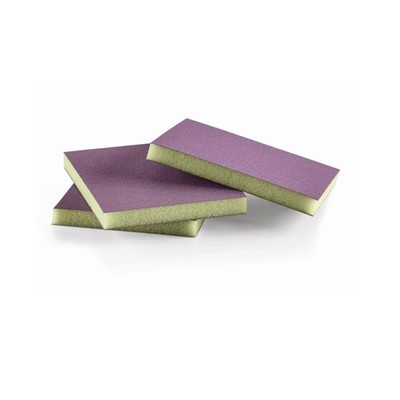
Soft Sanding Sponge Pad
During paint preparation and fine finishing work, rigid sandpaper often creates uneven sanding pressure on curves, edges, and delicate surfaces. This can leave visible scratch patterns, sanding marks, or excessive material removal before coating. Soft sanding sponge pads are designed to improve control during hand sanding by adapting more naturally to the shape of the work surface. The flexible foam structure helps create a more even sanding action while reducing pressure marks on sensitive areas.
Product Introduction
Products Description
Soft Flexible Foam Construction
- The sanding sponge pad uses a soft PU foam backing that conforms naturally to curved and irregular surfaces.
- The sponge adapts to contours without excessive pressure concentration.
- This helps reduce sanding marks, edge burn-through, and uneven surface scratches.
- Thicker soft-back sponges improve sanding consistency on rounded surfaces and contours.
Reusable Sponge Structure
- The high-density foam construction allows repeated cleaning and reuse.
- The sanding sponge maintains flexibility after extended sanding operations.
- Reduces abrasive consumption and lowers finishing costs.
- Suitable for continuous workshop and industrial sanding environments.
Wet & Dry Sanding Capability
- The sanding sponge pad supports both dry sanding and wet finishing applications.
- Wet sanding reduces dust buildup and sanding heat.
- Creates cleaner sanding conditions and finer-quality finishes.
Controlled Fine Sanding Performance
- The abrasive layer delivers stable cutting action while maintaining smooth surface refinement.
- The sanding process becomes easier to control during hand finishing.
- Improves surface preparation quality before painting, coating, or polishing.
High Resilience and Heat Dissipation: The sponge's elasticity minimizes deformation during use, ensuring stable, long-term performance. It also provides excellent heat dissipation, reducing heat buildup, maintaining sanding stability, and preventing damage to the workpiece from overheating.
Wet and Dry Dual-Purpose Design: The purple wet-and-dry sponge sanding pad is designed for both wet and dry sanding. In wet conditions, it effectively absorbs abrasives and moisture, improving sanding efficiency and reducing heat generation, thereby protecting the workpiece surface.
Multiple Application Areas: The microfine sanding sponge pad is versatile and suitable for a variety of materials, including metal, plastic, and wood. It can handle flat, curved, or uneven surfaces, achieving even sanding and consistent results across a wide range of applications.
Sanding Sponge Pad Microfine Specifications
|
Type |
SP503 |
|
Specification |
120*98*13mm |
|
Grain |
Premium Aluminum Oxide |
|
Backing |
Foam PU (Polyurethane solvent-free) |
|
Foam Type |
Soft foam |
|
Bonding |
Resin over Resin |
|
Coating |
2-sided |
|
Application |
Dry and wet sanding, particularly for wood, furniture, paint, and metal. |
|
Package |
250pcs/carton, Customized packages are available |
Grit to Guide
| Grit | Recommended Application |
| 60# | Heavy paint removal and rough leveling |
| 80# | Surface shaping and filler sanding |
| 100# | Putty correction and rough preparation |
| 120# | Edge smoothing and contour sanding |
| 150# | Fine surface leveling |
| 180# | Primer preparation |
| 220# | Surface finishing before coating |
| 240# | Fine finishing and blending |
Why Soft Sanding Sponge Pads Work Better on Curved Surfaces?
Compared with traditional abrasive sheets, soft sanding sponge pads provide:
- More even sanding pressure
- Improved contour flexibility
- Reduced scratch depth
- Smoother hand sanding control
- Better edge protection
- Lower rework rates
This makes them especially suitable for:
- Curved panels
- Detailed profiles
- Delicate coatings
- Irregular surfaces
FAQ
01. What is a soft sanding sponge pad used for?
02. Why use sanding sponge pads instead of regular sandpaper?
03. Are soft sanding sponge pads reusable?
You Might Also Like


Send Inquiry
